

Home › Everything under one roof › Birth control
Birth control
For most of a woman’s life, we’re focused on not getting pregnant.
We can tell you al lot about that. That is also womens’ care. Even if you have never been to our practice before, you are welcome. We are here for everyone.
If you’ve just given birth and are looking for a reliable form of contraception, you can come to us as well. We thought it would be nice to be able to visit your own trusted midwife for this piece of women’s care as well. After all, she knows exactly how your pregnancy, delivery and maternity went and can tailor the approach accordingly.
Hormone free brith control
More and more women are looking for hormone-free contraception — for example, if you’ve experienced side effects from hormonal methods. Hormone-free contraception allows you to maintain your natural menstrual cycle while preventing pregnancy in a different way.
There are different types of hormone-free contraception, but not all of them are equally reliable. For example, periodic abstinence is not recommended as a method to prevent pregnancy.
Below, you can read more about the different types of hormone-free contraception:
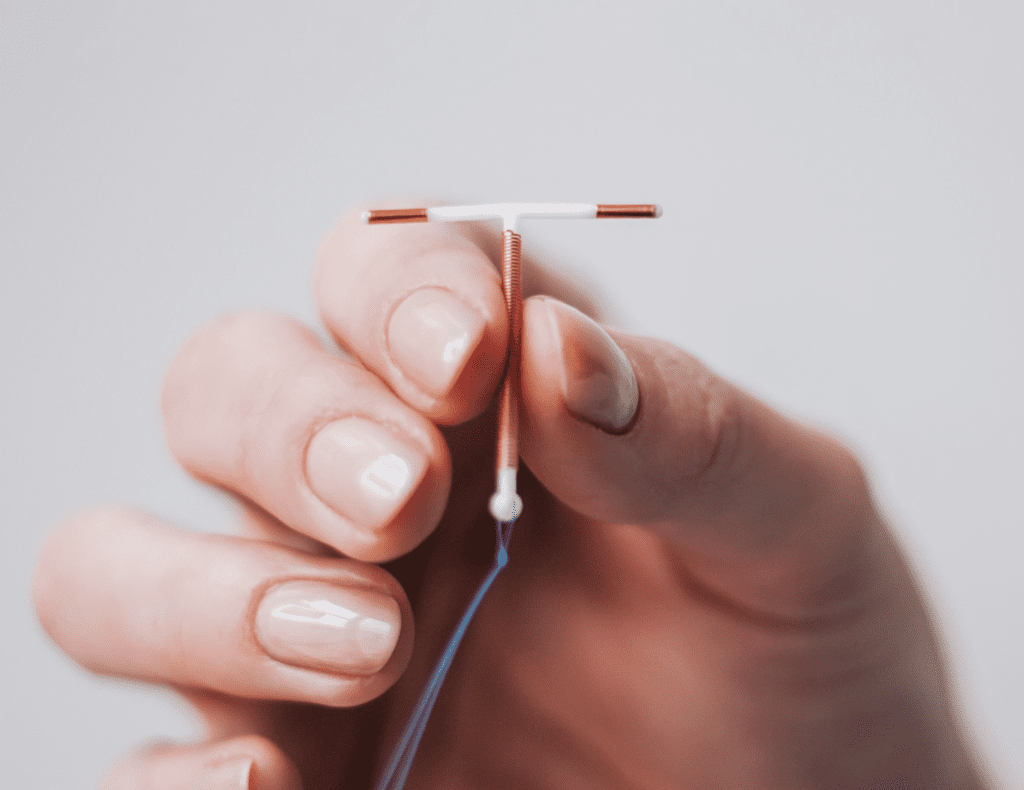
Copper IUD
The copper IUD contains copper ions that kill sperm. It can remain in place for up to 10 years. Once it’s removed, your fertility returns immediately. The copper IUD can also be used as emergency contraception. We can insert it for you. For more information, go to ‘placement’.
Barrier method
Barrier methods include the male condom and the female condom. This is the only form of contraception that also protects against STIs. These methods are even more effective when used in combination with a spermicide. Click here for more information
sterilisation
Hormone containing birth control
There are 2 kinds of hormone containing birth control:
Progesterone-only
The hormonal IUD contains progesterone and protects you against pregnancy for up to 8 years. Many women experience lighter or no periods with this IUD. We can insert it for you.
For more information, visit the ‘insertion‘ page.
The Implanon is a small rod that is inserted under the skin of your arm and protects you against pregnancy for three years. It works in the same way as the hormonal IUD, but from a different location
This pill is different from the ‘regular pill’ because it contains only one hormone. There is no break week, and you take the pill at the same time every day. Sometimes you may still get your period, but you should keep taking the pill daily. This pill is suitable to use during breastfeeding.
The injection is given by your doctor every 12 weeks in your upper arm. One shot protects you for 12 to 13 weeks! Click here for more information.
combination
Combination contraceptives contain the hormones progestogens and estrogens. The progestogen hormone prevents ovulation, makes the uterine lining impenetrable to sperm, and if an egg is released, it prevents it from implanting in the uterus. The estrogen hormone helps regulate your menstrual cycle. These contraceptives are not recommended during breastfeeding.
Contraception comes in many different forms and types. You can choose hormone-free options (like condoms and the copper IUD) or hormonal methods.
Hormonal contraception can contain just one hormone, progestin (such as the hormonal IUD, Implanon, injection, or mini-pill).
You can also choose a form of contraception with two hormones (the pill, NuvaRing).
For more information, see anticonceptie.nl.
If you are looking for a hormone-free contraceptive method, there are several options:
1. Condoms
2. Periodic abstinence (which has been proven not to be reliable for preventing pregnancy)
3. The copper IUD
4. Sterilization
If you are looking for a hormone-free contraceptive method, there are several options:
1. Condoms
2. Periodic abstinence (which has been proven not to be reliable for preventing pregnancy)
3. The copper IUD
4. Sterilization
Would you like an IUD or Implanon?
We insert IUDs and Implanon implants. Have you made your decision? Then fill out the form or give us a call! Together, we’ll discuss the next steps. For more information about the procedure, visit the ‘insertion’ page using the button below!
Frequently Asked Questions
Birth control comes in many different forms and types. You can choose hormone-free options (like condoms and the copper IUD) or hormonal methods.
Hormonal contraception can contain just one hormone, progestin (such as the hormonal IUD, Implanon, injection, or mini-pill).
You can also choose a form of birth control with two hormones (the pill, NuvaRing).
For more information, see anticonceptie.nl.
If you are looking for a hormone-free contraceptive method, there are several options:
1. Condoms
2. Periodic abstinence (which has been proven not to be reliable for preventing pregnancy)
3. The copper IUD
4. Sterilization
A copper IUD is a safe method to prevent pregnancy. It is not harmful to you and effective if you want to avoid getting pregnant.
Using a condom is also safe, as long as you use it correctly every time.
Other methods, such as the calendar method or tracking your temperature, have been proven to be insufficiently effective in preventing pregnancy. About 25% of women who use these methods become pregnant within one year.
IUD insertion can be painful, especially if you haven’t given birth before. That’s why we recommend taking paracetamol or ibuprofen beforehand and keeping your schedule clear afterward. You may experience cramping in your lower abdomen after the insertion.